
States we serve · Oklahoma
Oklahoma duplex insurance
One roof, two leases, and a deposit statute that governs the bank account before it governs any calendar. If you occupy one of the halves, a second Oklahoma rule turns on that fact and stops the day you stop.
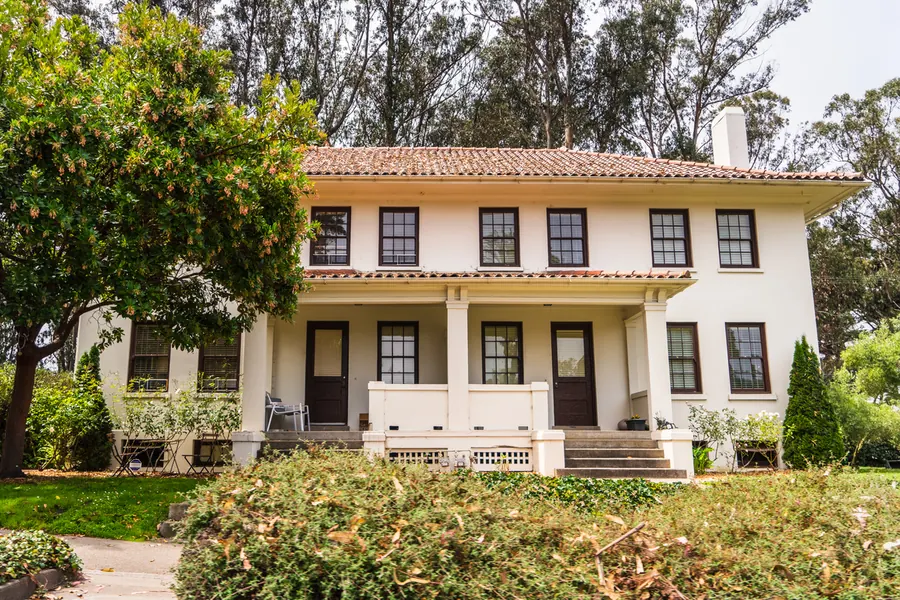

Oklahoma duplex regulations and licensing
What Oklahoma legislates about a small rental is the money and the paperwork around each tenancy, and on a two-unit building that arithmetic doubles in one place and stays single in another. The account is single. The counts are not. Getting that pairing straight is most of what an owner of a duplex here has to do differently from an owner of a house.
One account, and a deposit for each half
The Oklahoma Residential Landlord and Tenant Act runs the deposit as an escrowed fund the tenant has to claim, not one the owner pushes out on a calendar of its own.
Under 41 O.S. § 115 (Oklahoma Residential Landlord and Tenant Act, 41 O.S. § 101 et seq.) the money is escrowed inside the State of Oklahoma, at a federally insured financial institution, and the provision reaches every damage or security deposit you take rather than some threshold number of them. Read what that does and does not scale with. It does not scale with doors: an owner who occupies one half and lets the other, holding exactly one deposit, opens exactly the same account as an owner letting both. And it is a banking arrangement rather than a diary entry, so it has to exist before the first tenant signs anything.
Then the far end, which is where a duplex stops resembling a house. Nothing is counted until a tenancy has terminated, possession has come back to you and that tenant has demanded the money in writing — and the forty-five days run from whichever of the three lands last. Each half generates its own version of that sequence. A demand letter from one tenant starts nothing at all for the other, and the six-month cut-off after which an unclaimed deposit stops being the tenant’s runs separately for each of them too. The account is one account; the ledger inside it is two entries on unrelated timetables.
What Oklahoma actually requires of you
- Count the forty-five days from the last of three events — the tenancy terminating, possession being delivered, and a written demand arriving from the tenant — and note the statute frames that duty for the case where you propose to retain part of the deposit. 41 O.S. § 115(B)
- Open the escrow account inside the State of Oklahoma at a federally insured financial institution and keep every damage or security deposit in it — misappropriating that money is a criminal offense carrying county jail time and a fine measured against the amount taken, not a civil dispute. 41 O.S. § 115(A)
- Serve the itemized written statement by mail with return receipt requested, signed for by a person of statutory service age at that address, or hand it to the tenant in person if the tenant can reasonably be found. 41 O.S. § 115(B)
- Diary the six months after termination and leave an unclaimed deposit alone until they run — only then does it revert to you in consideration of the cost and burden of maintaining the escrow account, and the tenant’s interest in it ends at that moment and not before. 41 O.S. § 115(B)
- Write any flooding of the premises within the past five years into the rental agreement prominently and in writing whenever you know of it — leaving it out lets the tenant sue you for the personal property the water ruined. 41 O.S. § 113a(A)
- Disclose in writing, at or before the tenancy starts, who manages the premises, who owns them and who is entitled to accept service or notice, and keep that information current — anyone who fails to becomes a landlord under the act and an agent for receiving those notices and demands. 41 O.S. § 116(A)–(B)
Two of those clauses are worth reading twice with a second door in mind. The disclosure of who manages, who owns and who may accept service is owed at or before each tenancy begins, which on a duplex means writing the same facts twice and keeping both current — and an owner living on site is the one most likely to think it goes without saying. The flooding disclosure behaves the other way round: it is a fact about the premises, not about a unit, so if it belongs in one rental agreement it belongs in both.
What that means for you: Escrow the money inside Oklahoma at a federally insured institution the day you take it, then wait for the written demand — the forty-five days do not begin until the tenancy has terminated, possession has been delivered and that demand has arrived, and the tenant’s interest in an unclaimed deposit ends six months after termination.
Who enforces the housing rules, and who regulates the policy
The occupancy question that decides how Oklahoma fair-housing law reaches your rented half has a section of its own further down this page, because on a duplex it is the whole question rather than a footnote. The operative text sits at 25 O.S. § 1453(C)(1)(b); protected classes at § 1452(A). Enforcement sits with the Oklahoma Attorney General’s Office of Civil Rights Enforcement. What defending a complaint costs, and which part of a policy pays for that defense, belongs to tenant discrimination. Forms, rates and carrier conduct are a different office again: they are regulated by the Oklahoma Insurance Department.
Common Oklahoma duplex risks
Severe convective storm is what Oklahoma property placement is built around — tornado, hail and straight-line wind arrive inside the same systems, and the Insurance Department describes the market’s answer as an optional deductible applying only to wind or hail losses, taken apart from the deductible that answers for everything else. Lightning rounds out what the standard form covers. Flood is not on that form and is its own placement through the National Flood Insurance Program. Earthquake is not on it either, and in Oklahoma that gap is a live question rather than a footnote: the Insurance Department says earthquake damage sits outside the standard policy and comes only as an endorsement or a stand-alone contract, that quakes have increased here over recent years, and that whether a given policy answers for manmade earthquakes tied to oil and gas activity is something to confirm with an agent before it matters. Where the admitted market declines, the route is the Oklahoma Market Assistance Program — which the statute creating it says is not a carrier capable of assuming insurance risks, and whose power is to require its member insurers to issue the policy instead.
Take the deductible point first, because it is a choice rather than a fact about the building. A retention that answers wind and hail on its own terms attaches to the structure, and a duplex is one structure — so a single storm meets that figure once no matter how the halves are leased, and the whole of what the building earns is standing behind the number you picked. An owner with several separate addresses can be wrong about it in one place at a time. A two-unit owner cannot.
It is worth knowing exactly what the Oklahoma Market Assistance Program (OK-MAP) named above can be asked for, because the answer decides what has to be in hand before you ask. Nothing of its own. The act creating it states it is not a carrier capable of assuming insurance risks; it exists to assist in the placement of homeowners’ and liability coverage, and its power is to require member insurers to issue policies to eligible applicants. Every insurer licensed in Oklahoma for both property and casualty lines is a member as a condition of doing business in the state. An applicant reaches it after coverage was canceled or nonrenewed by the current carrier and two licensed insurers then refused, or after a premium rose by seventy-five percent or more over the previous year. Market Assistance Association Act, 36 O.S. §§ 6412, 6413(5), 6414(A)(1), 6414(B)(1)(f)
For a two-unit owner that route rests on one address. There is no second building whose clean history could carry the submission, so the notices are the file: keep the cancellation or nonrenewal as it arrives, keep the refusals that follow, and bring them together rather than reconstructing them later.
Earthquake is the same shape of decision. Adding the endorsement, or buying the stand-alone contract, is one decision about one structure, and both leases sit behind whichever answer you give — there is no half of the building you could sensibly leave outside it. The Insurance Department’s instruction about manmade quakes tied to oil and gas activity is worth treating as an instruction rather than a caution: put the question to an agent and get the answer read back off the wording that is actually on the building.
The exposure that is not weather at all is what the two halves share. Where one supply run, one heater or one service panel answers to both addresses, the failure is single and the consequence is not. A failure like that asks two questions and gets two answers: property coverage deals with the structure both leases sit on, and loss of rents deals with the money that stops while the work runs — and on a duplex there is no third door still paying through it.
A standard property form in Oklahoma answers for Tornado, Hail, Straight-line wind, and Lightning. It does not answer for Earthquake and Flood, which are bought as their own placements, and the lines that respond where it does answer are property coverage, loss of rents, and general liability.
Common Oklahoma duplex claims we see
Hail is the claim that arrives most often here, and on a duplex it arrives as one roof. Whatever the two leases say, the covering over both doors was installed at one time and is argued about as one surface, so the question of whether the damage was the storm or the service life is a single argument with two tenancies waiting on the outcome. Owners who settle these cleanly are the ones holding a dated inspection from before the season as well as after it.
Freeze losses are the recurring winter shape, and they find whichever line runs coldest. On a two-unit building that is frequently a line serving both halves, or one running through the wall between them, so a failure that would have emptied one unit in a house empties the building here. If one half is standing empty between tenants and the heat is down in it, the exposure is not confined to the empty side.
Liability tends to start where the two households pass each other: the drive, the walk to the mailboxes, the step or landing both doors use, the place the bins go. General liability answers a claim of injury on premises you control, and on a duplex the ground between the doors is almost always still yours rather than handed to one lease — which is why we ask early what each lease actually gives away.
Why Oklahoma duplex owners choose Rental Guard
Oklahoma is the state where the deposit clock does not start until the tenant asks in writing, and where the Insurance Department tells owners to confirm with an agent whether a policy answers for oil-and-gas-related earthquakes. A two-unit owner meets the first of those at every turnover and the second the first time an adjuster asks what the wording says, and neither is a form you fill in — they are conversations. Nothing in this book is bigger than four doors, so a duplex is read against buildings its own size rather than sorted toward whichever appetite happens to be nearest. The policy structure itself is set out on the landlord insurance pillar, and the three- and four-door buildings we also write have their own at triplex insurance and quadplex insurance. Quotes are placed by a licensed agent this site names, under the NPN in the footer.
Owner-occupied, or both units let
On an Oklahoma duplex this is not only an underwriting question, which is what makes it worth a section. Occupancy decides how the building is presented to a market and what the income side is scoped to, and it also decides which fair-housing rules reach the half you rent out — and the second consequence is the one owners almost never see coming.
Oklahoma exempts the rental of rooms or units in a building of no more than four families living independently of each other, but only while the owner maintains and occupies one of those living quarters as a residence — and outside that carve-out the state list adds age to the federal grounds.
Notice what that provision is conditioned on. It is not the door count standing on its own — it is the door count together with your own residence in the building, and the second condition can change without anyone amending a lease. Let both halves and you are outside the carve-out from that point, on a tenancy you may have been screening for under a different assumption a month earlier. Owners who have read about a federal small-building exemption are often surprised by how much work the occupancy clause is doing.
The operating answer is the same on either side of it, which is why it is worth adopting before you need to know which side you are on: one written screening standard, applied identically to both halves, and kept. Living next to the person you are screening makes that record more useful rather than less.
What that means for you: Settle the question on where you actually sleep rather than on the unit count alone — the carve-out holds only while you keep and occupy one of the living quarters, it collapses the day you stop, and everywhere it does not reach you are answering to a protected list that runs past the federal one.
Owners move between the two arrangements more often than they expect — occupy for a few years, then let both sides, sometimes back again. Tell us in the month it happens rather than at the renewal afterwards. What the policy is covering changed on the day the keys did, and so did which rules reach the other half.
Major Oklahoma duplex markets
The markets below are not one underwriting problem in eight places. Shared systems, a single roof age, two tenancy calendars and one concentrated income are four different reasons a two-unit Oklahoma building behaves the way it does.
- Tulsa. Older midtown two-unit stock frequently runs one supply line, one heater and one service panel to both addresses, so the question underwriting asks first is not how the halves are leased but how much of the building they actually have in common.
- Oklahoma City. The optional wind-or-hail retention is a single decision about a single structure, and a two-unit owner makes it with both rents standing behind it — there is no second address on the file to average that choice against.
- Edmond. Newer side-by-side two-unit construction puts one roof plane of one age over both doors, which turns the eventual re-roof into one decision, one contractor and one period in which neither half is comfortable to live in.
- Norman. Where both leases run on an academic calendar the halves can end in the same fortnight, so the vacancy question here is asked about the whole building rather than about a share of it, and the re-let window is the same window twice.
- Stillwater. Owner-occupied halves are ordinary around a campus town, and a building that is partly a residence and partly a let goes to market as one risk carrying two occupancy stories rather than as two files.
- Lawton. Tenancy alongside a large installation turns over on orders rather than on a local season, which puts one half mid-re-let while the other is still under lease — two calendars running independently under one roof and one policy.
- Midwest City. Much of the small rental stock here reads as one house from the street and is two dwellings on the leases, and what the exterior shows is not what the underwriter needs: which meter, which heater and which entrance each half actually has.
- Enid. A two-unit building is often the whole of a smaller-market owner’s rental holding, so a loss that takes the structure out of service takes the entire income with it and the length of the re-let, not the size of the repair, is what hurts.
How the rules differ across the line
- Duplex insurance in Texas — a deposit accounting also gated on a document the tenant hands over, but with a count run from surrender and a presumption of bad faith against an owner who misses it, where Oklahoma simply never starts counting.
- Duplex insurance in Arkansas — a security-deposit subchapter that switches off entirely for an owner whose household and entities hold five or fewer dwelling units, where Oklahoma’s escrow duty attaches to the deposit itself and never asks how many doors you have.
- Duplex insurance in Kansas — a statute that loads the front of a tenancy, putting a joint written move-in inventory inside the first five days of occupancy, where Oklahoma leaves the front alone and regulates the bank account instead.
Related reading
Oklahoma duplex insurance FAQs
I live in one half of my duplex. Does Oklahoma fair housing reach the other half?
The state carve-out is drawn around a building of no more than four families living independently of each other, and it holds only while the owner maintains and occupies one of those living quarters as a residence. So it reaches while you live there and stops reaching the day you leave. Outside it, the state grounds at 25 O.S. § 1452(A) run past the federal ones and include age.
I only take one deposit. Do I still need the Oklahoma escrow account?
Yes. 41 O.S. § 115(A) is written about every damage or security deposit rather than about how many of them you hold, and what it fixes is where the money sits: an escrow account inside the State of Oklahoma, at a federally insured financial institution. One tenant or two, it is the same account, and it is opened before the first deposit arrives.
Both halves turned over this year. Do the forty-five days run together?
No — each tenancy carries its own count. Nothing is counted until that tenancy has ended, possession has come back to you and that tenant’s written demand has arrived, so a letter from one half starts nothing for the other. Expect a duplex to run two schedules that coincide only by accident, and diary the day each demand lands rather than each move-out date.
Is duplex insurance a different product from landlord insurance?
It is a landlord policy written on a building that contains two dwelling units, and dressing that up would be selling you a word. What is genuinely different in Oklahoma is that one escrow account answers to two tenants on two unrelated timetables, and that a fair-housing carve-out turns on whether you sleep in one of the halves. The form underneath is the same form.
Does living in one half change what the policy covers?
It changes how the building goes to market and what the income side is scoped to, because only one rent is at risk while you occupy the other unit. It also changes practical questions an underwriter asks — entrances, meters, laundry, who holds which key. Tell us the month it changes rather than at the renewal afterwards, because the cover changed on the day you moved.
Do both of my tenants have to be told who manages the building?
Yes, in writing, at or before each tenancy starts: who manages the premises, who owns them, and who is entitled to accept service and notice, kept current as it changes. On an owner-occupied duplex the answer is usually you on both leases. 41 O.S. § 116(A)–(B) makes anyone who fails to disclose it a landlord under the act and an agent for receiving those notices and demands.
Does the flooding disclosure go into both rental agreements?
Where you know the premises has flooded within the past five years, 41 O.S. § 113a(A) wants it prominently and in writing in the rental agreement — and flooding is a fact about the building rather than about one half of it. So it belongs in each agreement you sign. Leaving it out lets that tenant sue you for the personal property the water ruined.
Get an Oklahoma duplex insurance quote
Send us the building and the policy you have now. and we will tell you what the escrow account and the occupancy clause are doing to your two leases.
Get a Free Quote